


Zucchini has a legendary reputation among gardeners, the vegetable so productive that growers famously leave surplus on their neighbors’ doorsteps. It’s also a plant with a reputation for sprawling, gobbling up nine square feet of garden and elbowing everything else aside. So here’s the good news: learning how to grow zucchini in a small garden is entirely doable, and with the right variety you can get that famous abundance from a single pot on a patio.
The secret isn’t a bigger garden, it’s choosing a compact bush variety, giving it a generous container, and understanding one quirk about pollination that trips up nearly every beginner. Get those three things right and one plant can keep your kitchen in summer squash from midsummer to frost. This guide covers all of it, from picking a variety to harvesting at the perfect moment.
Can You Grow Zucchini in a Small Space?
Yes, zucchini grows very well in small gardens and containers. Choose a compact “bush” variety like ‘Eight Ball’ or ‘Bush Baby’, plant one per large container (at least 5 gallons, ideally bigger, and 12+ inches deep), give it 6 to 10 hours of full sun, water consistently, and hand-pollinate the flowers if bees are scarce. A single plant can produce dozens of zucchini through the summer.
The two things that decide your success are variety and pollination. A sprawling vining type will overwhelm a small space, and even a healthy plant will drop every fruit if its flowers aren’t pollinated. Solve both, and zucchini becomes one of the most rewarding crops a small-space gardener can grow.
Why Zucchini Suits Small Gardens So Well
It might seem counterintuitive to grow a famously big plant in a small space, but zucchini earns its spot better than almost anything:
- Extraordinary yield per square foot. One plant occupying a single pot can produce dozens of fruits over a season few crops give back so much from so little ground.
- Speed. Many varieties are ready to harvest in 35 to 50 days, so you’re eating within weeks rather than months.
- It’s nearly foolproof. Zucchini germinates readily, grows fast, and forgives beginner mistakes.
- Purpose-bred compact varieties exist. Breeders have done the hard work, giving us bush types with a 3-foot footprint that still crop heavily.
- It’s beautiful. Big architectural leaves and huge golden flowers make it an ornamental plant in its own right.
The one honest caveat: zucchini needs real sun and real water. Give it a bright spot and consistent moisture and it will astonish you.
Meet the Zucchini (Summer Squash)
Zucchini (Cucurbita pepo), also called courgette, is a warm-season summer squash and a member of the cucurbit family alongside cucumbers, melons, and pumpkins. Unlike winter squash, it’s harvested young, while the skin is still tender and edible, which is why it’s ready so fast and produces so relentlessly.
It’s also genuinely good for you. Zucchini delivers vitamins A, C, and K, plus folate, manganese, and potassium. most of those nutrients live in the skin, so there’s no need to peel it. As a general rule, the darker the zucchini, the more nutrients it carries. Best of all, zucchini is quick: many varieties go from seed to first harvest in just 35 to 50 days.
Bush vs Vining: The Most Important Choice for Small Gardens
If you take one thing from this guide, make it this. Zucchini comes in two growth habits, and the difference is dramatic in a small space:
- Vining varieties send out long, rambling vines that can swallow an entire garden row. Wonderful if you have space, disastrous if you don’t.
- Bush (compact) varieties grow as a tidy, upright clump. These are bred for small gardens and containers, and they’re what you want.
Here are proven compact performers for small spaces:
| Variety | Why It Works | Notes |
|---|---|---|
| Eight Ball | Round, baseball-sized fruit; only ~3-foot spread | Harvest in about 40 days; powdery mildew resistant |
| Bush Baby | Compact plant bred for smaller, striped fruit | Great for pots; harvest at ~4 inches |
| Patio Star | Purpose-bred for container growing | Compact and productive |
| Fordhook Zucchini | Classic reliable bush type | Widely available |
| Buckingham Patio | One of the smallest; manages in a 5-gallon bucket | Ideal for balconies |
“The balcony gardener’s secret weapon: look for a parthenocarpic variety. These remarkable plants set fruit without any pollination at all, no bees required. If you’re gardening on a high balcony, in a dense city, or anywhere pollinators are scarce, a parthenocarpic zucchini removes the single biggest obstacle to a harvest.”
Choosing a Container
Compact doesn’t mean small roots. Even bush zucchini are big, thirsty plants, so give them room:
- Minimum size: 5 gallons for the smallest varieties.
- Ideal: at least 12 inches deep and 16 to 18 inches across, bigger is genuinely better, and a 15- to 25-gallon container produces noticeably healthier, more productive plants.
- One plant per pot. Zucchini leaves are enormous; crowding invites disease and cuts your yield.
Material matters. Porous containers like terra cotta, unglazed ceramic, or fabric grow bags provide excellent drainage and airflow (they dry faster, so watch watering). Plastic works but raises the risk of waterlogged roots, so make sure it has plenty of drainage holes. Large fabric grow bags are a great, affordable option at bigger sizes. Whatever you choose, start with a clean container to avoid carrying over disease. Our container gardening guide for beginners covers pot selection in more depth.
The Right Soil
Never fill a container with garden soil, it compacts, smothers roots, and can carry weed seeds, disease, and squash vine borer larvae. Use a quality, lightweight potting mix built around peat or coco coir, bark, and perlite or vermiculite for drainage and aeration, then blend in some compost for fertility. Fill to about two inches below the rim. Zucchini are hungry plants, so that compost-enriched start pays dividends all season. If you’re growing in a bed rather than a pot, work in a generous few inches of compost before planting, zucchini thrives in rich, loose, moisture-retentive soil that still drains freely.
How to Plant Zucchini: Step-by-Step
- Step 1: Wait for Warm Soil
Zucchini is frost-tender and hates cold ground. Plant one to three weeks after your last frost, once soil is 70–85°F and daytime temperatures are consistently above 70°F. Check your last frost date to time it. Planting into cold soil causes rot and stunted plants.
- Step 2: Sow Seeds Directly (or Transplant Carefully)
Zucchini prefers to be direct-sown, because its roots dislike disturbance. Plant two or three seeds about an inch deep in the center of the container, at least four inches from the edges. Seeds sprout in 7 to 10 days. If you’d like a head start in a short season, sow directly into pots indoors about a month before the last frost, then move them out once it’s warm or buy transplants and handle the root ball very gently.
- Step 3: Thin to One Strong Seedling
Once seedlings are a few inches tall, choose the strongest and snip the others off at soil level. It’s tempting to keep them all resist. A single plant with room to breathe outproduces two crowded ones every time.
- Step 4: Add Vertical Support
Here’s a small-space trick worth doing at planting time: put a sturdy tomato cage over the seedling, or set a stake for tying. Zucchini leaves and fruits get big and heavy, and unsupported stems dangling over a pot edge can snap under their own weight. Training the plant upward also saves precious floor space and dramatically improves airflow. If you’re growing a vining type on a trellis, anchor the pot to a railing so it can’t topple.
- Step 5: Position for Full Sun and Pollinators
Zucchini wants at least six hours of direct sun, with eight to ten being ideal, a south-facing spot is perfect. Just as importantly, place it near flowers that attract bees. Borage, alyssum, nasturtiums (which also repel squash bugs), lavender, mint, and bee balm are all excellent. Our companion planting guide has more pairings, and attracting more pollinators to your space pays off across the whole garden.
Zucchini Plant Care: Water, Feeding and Airflow
- Watering. Consistency is everything. Zucchini’s huge leaves transpire a lot of water, and containers dry out fast, check daily and water as soon as the top inch of soil is dry, going deeper and more often in heat. Erratic watering is the direct cause of blossom end rot. Water at the base and keep the leaves dry, since wet foliage invites powdery mildew. A DIY drip irrigation system makes this effortless.
- Feeding. Zucchini are heavy feeders. Mix a slow-release fertilizer into the potting mix at planting, or feed every four weeks with a balanced, water-soluble fertilizer. Container plants need more feeding than garden ones since there’s less soil to draw from. Our guides to understanding NPK ratios and homemade organic fertilizer can help.
- Airflow and pruning. Powdery mildew, that white dusty coating on leaves is zucchini’s most common ailment, and it thrives where air is still and humid. You can prune away some of the largest lower leaves to open the plant up and let light reach the base. Just don’t strip it bare; those leaves are the plant’s engine.
The Pollination Problem (and How to Fix It)
This is the number one complaint about zucchini: “My plant is covered in flowers but I’m not getting any fruit.” Here’s what’s happening.
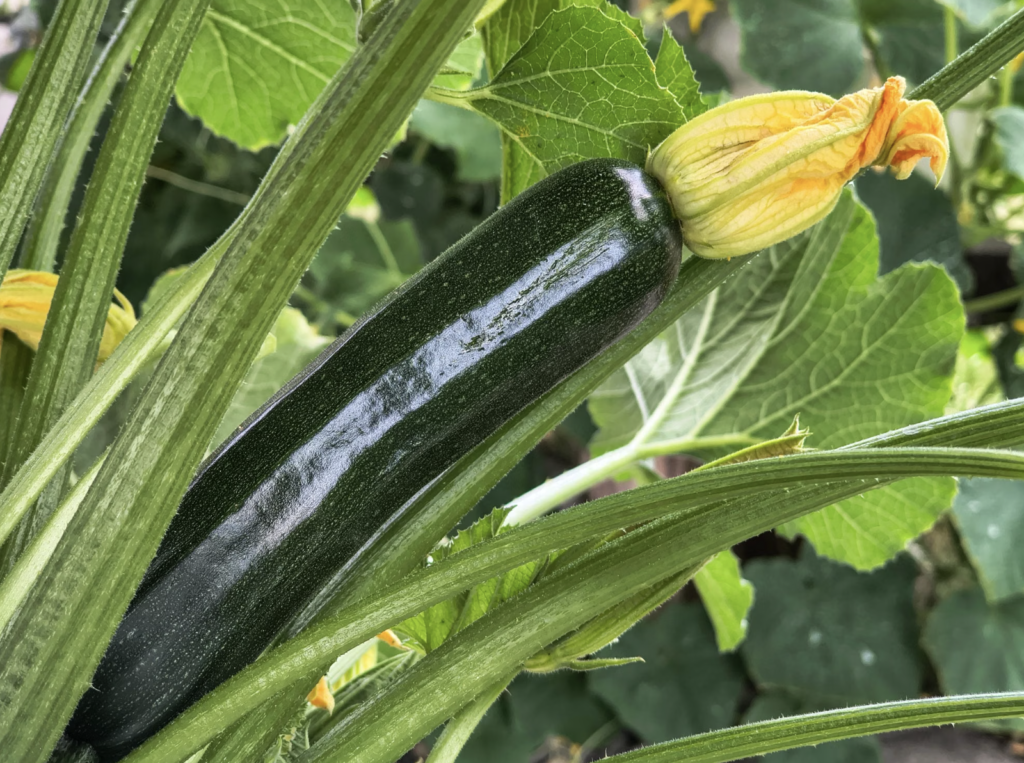
Zucchini produces separate male and female flowers on the same plant. Male flowers appear first, often for a week or two before any females opens sitting on a thin, plain stem. Female flowers have a thick base behind the bloom that looks like a tiny baby zucchini. That miniature fruit only swells into a real zucchini if pollen travels from a male flower to the female. Without pollination, the little fruit yellows, shrivels, and rots off.
So if you’re seeing flowers drop early in the season. Relax, those are almost certainly males, and females will follow. But if baby zucchini keep rotting at the blossom end, you have a pollination problem.
Hand-pollinating takes thirty seconds. In the morning, when flowers are open:
- Find an open male flower (thin stem) and snip it off.
- Peel away the petals to expose the pollen-covered stamen in the center.
- Brush the stamen gently against the stigma inside an open female flower (the one with the baby fruit at its base). A cotton swab or small brush works just as well.
That’s it. Do this each morning you spot a fresh female flower and your fruit set will improve dramatically. Good news for small gardens: you only need one plant, zucchini is self-pollinating, so a single plant can produce a full harvest. Growing two just raises the odds that flowers overlap and get pollinated naturally.
In our experience, hand-pollination is the habit that transforms a frustrating zucchini season into an overwhelming one. Gardeners who write off their plant as “a dud” after weeks of dropped fruit are almost never dealing with a sick plant, they’re dealing with a pollination gap, often because the flowers only stay open for a single morning and the bees didn’t happen to show up in that window. Once you get into the rhythm of checking the plant with your morning coffee and dabbing any open female flower, the fruit set becomes reliable almost overnight. It takes less time than watering, and it’s the single highest-return thirty seconds you’ll spend in a small garden.
Harvesting Zucchini
Here’s the productivity secret that separates a good zucchini harvest from a legendary one: harvest early and harvest often.
Most zucchini are ready in just 35 to 50 days, and the temptation is to let them grow big. Don’t. Baseball-bat zucchini are watery, seedy, and bland, and more importantly, a plant carrying oversized fruit slows down and stops producing. Picking constantly tricks the plant into making more.
Harvest at about 4 to 6 inches long for most varieties (compact types produce smaller fruit than the supermarket ones, so don’t wait), or at baseball size for round varieties like ‘Eight Ball’. Cut the stem with a sharp knife or snips rather than twisting, and check the plant every day or two at peak season, zucchini can double in size overnight.
Don’t overlook the blossoms, either. Male flowers (which you have in surplus) are a delicacy. stuff them, batter them, or fry them. It’s a wonderfully low-waste way to enjoy even more from a single plant. Store harvested zucchini in the fridge for about a week, or grate and freeze it for zucchini bread and soups all winter.
And when the famous glut arrives and it will, zucchini’s mildness becomes its superpower in the kitchen. It’s brilliant sliced and roasted or grilled, grated into fritters and bread, spiralized into noodles, folded into soups and curries, or simply sautéed with garlic. Grated zucchini freezes especially well in measured portions, so a productive summer plant quietly stocks your freezer for winter baking. Few crops turn so little space into so much genuinely useful food.
Common Problems and How to Fix Them
| Problem | Likely Cause | The Fix |
|---|---|---|
| Flowers but no fruit | Male flowers only, or poor pollination | Wait for females; hand-pollinate; add pollinator plants |
| Baby zucchini rot and drop | Unpollinated female flowers | Hand-pollinate each morning |
| White powdery coating on leaves | Powdery mildew (still air, wet foliage) | Improve airflow; prune some leaves; water at the base |
| Rot at the blossom end of fruit | Inconsistent watering | Water evenly as soon as the top inch dries |
| Sudden wilting of whole plant | Squash vine borer | Inspect stems; use row covers early in the season |
| Ragged holes in leaves and flowers | Cucumber beetles (can spread bacterial wilt) | Use floating row covers; neem oil; sticky traps |
| Small, misshapen fruit | Incomplete pollination | Hand-pollinate; encourage more bees |
A note on row covers: they’re excellent protection from borers and beetles, but they also block bees. so remove them once flowering starts, or commit to hand-pollinating. It’s also worth planting a second zucchini a few weeks after the first, so that if borers take out your original plant midsummer, a healthy successor is already coming along behind it.
Is Growing Zucchini Worth It?
Wonderfully so. Zucchini is one of the most generous plants in the vegetable world: fast, forgiving, and so productive that one healthy plant in a single pot can feed a household all summer. For small-space gardeners, it’s proof that you don’t need a big yard to grow real, satisfying quantities of food. just a sunny corner, a big container, and thirty seconds a morning with a cotton swab.
Ready to build out your small-space vegetable garden? Zucchini pairs well with other easy crops. Try growing tomatoes in containers, bell peppers from seed, or cucumbers grown vertically , a fellow cucurbit that loves the same conditions. Explore the full Vegetables collection, part of the broader EcoGardenHub Plant Library, or see our roundup of the best vegetables for container gardening.
Pick a compact variety, give it a big pot and your sunniest corner, and get ready, by midsummer you may be the one leaving zucchini on your neighbors’ doorstep. It’s a wonderful problem to have, and proof that a small garden can be every bit as abundant as a big one.
Frequently Asked Questions
- Can you grow zucchini in a container? Yes, easily. Choose a compact bush variety, use a container at least 5 gallons (ideally 12+ inches deep and 16 to 18 inches wide), plant one per pot, and give it full sun and consistent water.
- Why does my zucchini have flowers but no fruit? Early in the season, the plant produces male flowers first, which naturally drop off, followed by female Flowers. If baby zucchini rot and fall, the female flowers aren’t being pollinated, so hand-pollinate in the morning or attract more bees with nearby flowers.
- Do you need two zucchini plants to get fruit? No. Zucchini is self-pollinating, so one plant can produce a full harvest. Growing more than one simply increases the chance that male and female flowers open at the same time and get pollinated naturally.
- How do you hand-pollinate zucchini? In the morning, snip an open male flower (thin stem), peel back the petals to expose the stamen, and brush it gently inside a female flower (the one with a tiny fruit at its base). A cotton swab works too.
- What is the best zucchini variety for small gardens? Compact bush varieties are best. ‘Eight Ball’ has only a 3-foot spread and matures in about 40 days, while ‘Bush Baby’, ‘Patio Star’, and ‘Buckingham Patio’ are all bred for containers. For balconies without bees, choose a parthenocarpic variety.
- How big should zucchini be when you pick it? Harvest at about 4 to 6 inches long for most varieties, or baseball size for round types. Smaller zucchini taste far better, and frequent picking keeps the plant producing, oversized fruit slows it down.
- Why do my zucchini leaves have white powder on them? That’s powdery mildew, a common fungal issue caused by still, humid air and wet foliage. It rarely kills the plant. Improve airflow, prune a few large leaves, and water at the soil line rather than overhead.