A cucumber vine doesn’t need much convincing to climb. Within minutes of a tendril brushing against string or wire, it starts to coil, gripping tightly enough to hold the whole plant through a stiff wind. The plant already wants to go up. Your only job is to give it something worth climbing.
That single shift changes almost everything about growing cucumbers. Learning how to grow cucumbers vertically means straighter, cleaner fruit, dramatically less disease, and a plant that occupies a foot of ground instead of sprawling across a whole bed. You’ll also stop crawling around on your hands and knees hunting for cucumbers that quietly turned into baseball bats under the foliage. This guide covers everything: choosing the right variety, picking a trellis, training vines without hurting them, and harvesting more fruit for longer.
How Do You Grow Cucumbers Vertically?
Choose a vining (not bush) cucumber variety, install a sturdy 5- to 6-foot trellis before planting, and plant seedlings at its base. When vines reach 8 to 12 inches, gently guide them onto the support and let their tendrils grip. Check every 3 to 4 days to redirect wayward vines, water deeply at the soil line, and harvest every 1 to 2 days once fruit starts coming.
Two things decide your success: picking a vining variety (a bush type will simply ignore your trellis) and building the support before you plant so you never disturb established roots. Everything after that is mostly the plant doing the work.
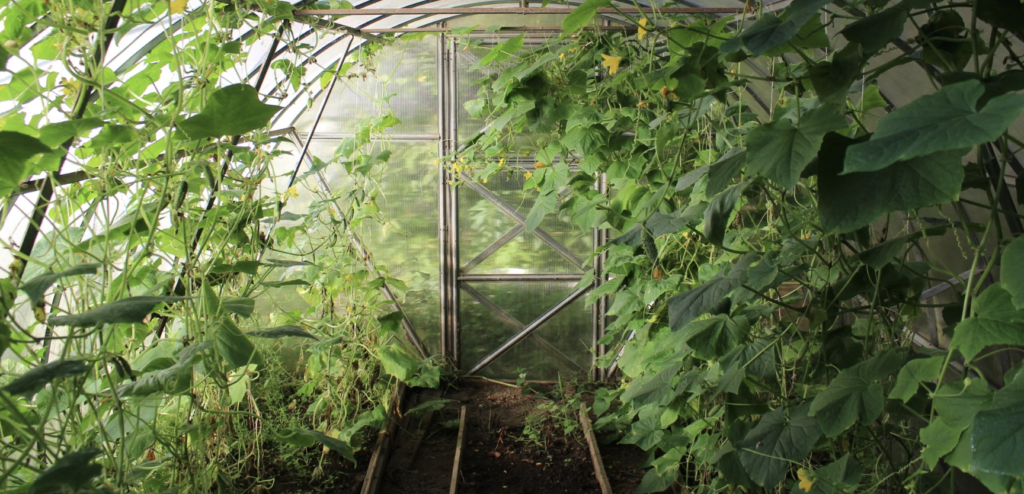
Explore a thriving greenhouse filled with cucumber vines and greenery, showcasing modern farming’s growth potential.
Why Grow Cucumbers Vertically? (The Science)
Vertical growing isn’t just a space trick, there’s real plant science behind why it produces healthier plants:
It directly cuts disease. Downy mildew, the most destructive cucumber disease, needs moisture sitting on the leaf surface in order to germinate and infect. When you lift a vine off the ground, the canopy opens, wind moves through, and wet leaves dry in a fraction of the time. You’re not just “improving airflow”, you’re shrinking the window in which disease can establish at all.
Cleaner, straighter fruit. Cucumbers resting on soil develop pale patches and soft spots where they touch the ground, often rotting before you spot them. A hanging cucumber grows straight, colors evenly, and stays clean.
Enormous space savings. A sprawling cucumber can claim 10 to 20 square feet of ground. The same plant trained upward uses about a foot of ground while fruiting along 5 to 6 feet of vertical vine.
You actually find the fruit. Every cucumber hangs in plain sight at picking height, no more discovering a bitter, oversized monster you missed for two weeks.
Room underneath. You can tuck fast, shade-tolerant crops like leaf lettuce or arugula at the base while the vines are young.
No scratched arms. Cucumber stems are prickly; harvesting at eye level is far more pleasant.
Choose a Vining Variety (Not a Bush Type)
This is the mistake that quietly ruins the whole plan. Cucumbers come in two habits:
Vining (indeterminate) types produce long stems with grasping tendrils, climb naturally, grow 4 to 6 feet or more, and fruit over a long season. These are the ones you want.
Bush types stay compact and don’t climb at all. They’re fine plants, but they’ll waste a trellis entirely.
Check the seed packet or plant tag, it will say. Here are proven climbers:
Variety
Type
Why Grow It
Marketmore 76
Slicing
The beginner’s best bet: vigorous climber, resists three common diseases, heavy reliable crops
Suyo Long
Slicing
Best for hot climates; the long ribbed fruit grows perfectly straight when hanging
Homemade Pickles
Pickling
Classic productive pickler for a trellis
Sumter
Pickling
Disease-resistant and dependable
Lemon
Novelty
Round yellow fruit; a charming, vigorous climber
Mini Munch
Snacking
Snack-sized fruit, reaches about 5 feet, great for small spaces
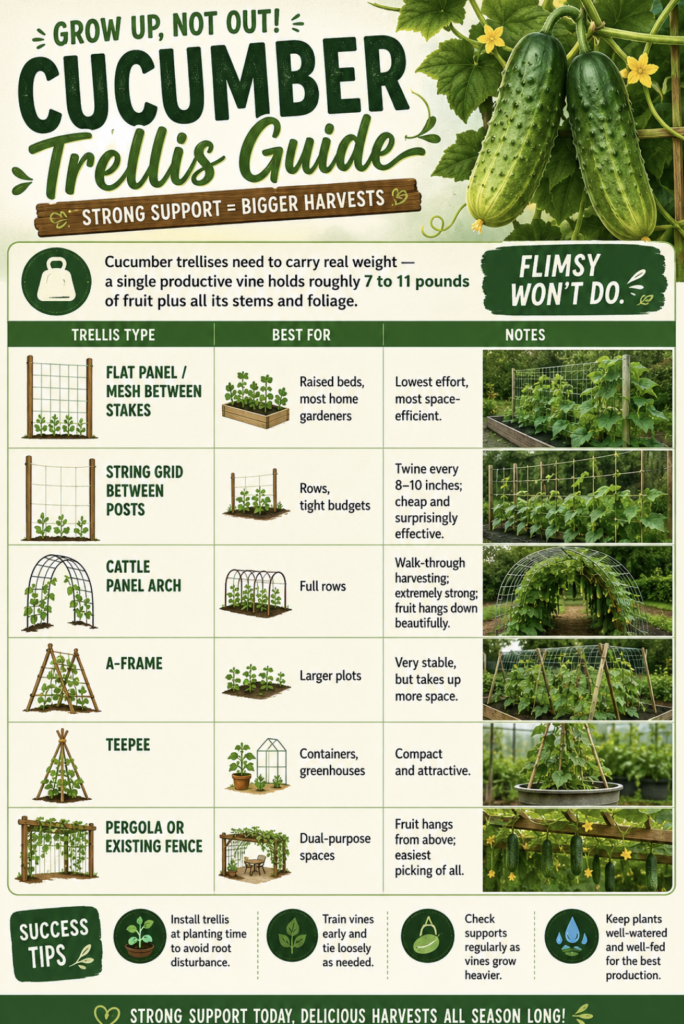
Choosing Your Trellis
Cucumber trellises need to carry real weight, a single productive vine holds roughly 7 to 11 pounds of fruit plus all its stems and foliage. Flimsy won’t do.
Choosing cucumber Your Trellis
Sizing it right: aim for about 5 to 6 feet of height tall enough for a vigorous vine, but still within reach at harvest, since a trellis you need a ladder for defeats the purpose. Drive stakes or posts at least 12 inches into the ground. For string and netting systems, space your horizontal supports 6 to 8 inches apart vertically, so a climbing tendril always has a contact point within reach; wider gaps let vines grow past a level without attaching, risking a heavy section breaking loose.
Before anything else, get your structure firmly in place. Driving stakes into a bed after seedlings are growing risks tearing roots and bending stems you can’t undo. Building first also tells you exactly how many plants you have room for.
Step 2: Prepare Rich Soil and Plant After Frost
Cucumbers are hungry, thirsty, warm-season plants. Work plenty of compost or well-rotted manure into the soil before planting they need genuinely fertile ground. Wait until all danger of frost has passed and the soil is warm; check your last frost date. You can direct sow at the trellis base, or start seeds indoors a few weeks early for a head start (see our seed starting guide). Give them full sun 6 to 8 hours minimum.
Step 3 Space Closer Than the Packet Says
Here’s a bonus of going vertical: because plants aren’t competing for horizontal light, you can plant tighter than the seed packet recommends for sprawling. Space slicing cucumbers 12 to 24 inches apart along the trellis and pickling types 12 to 18 inches. In raised beds, plant along the edge so the trellis doesn’t shade your other crops, leaving about 6 inches between the planting hole and the bed wall for root room.
Step 4: Start Training at 8 to 12 Inches
Timing matters here. Begin guiding vines toward the trellis when they’re 8 to 12 inches long before the stems lignify and turn brittle. Gently straighten each vine and lean it against the support, or loosely tie it with soft ties or garden twine every 6 to 8 inches of growth. Once a tendril finds the structure, it takes over.
Step 5L: Check Every 3 to 4 Days
Cucumbers are enthusiastic but not always well-behaved. Gravity pulls them down, and they’ll happily climb your tomatoes instead. Do a quick vine check every three or four days through peak growth, redirecting anything that’s gone rogue back onto the trellis. That’s genuinely the whole maintenance routine.
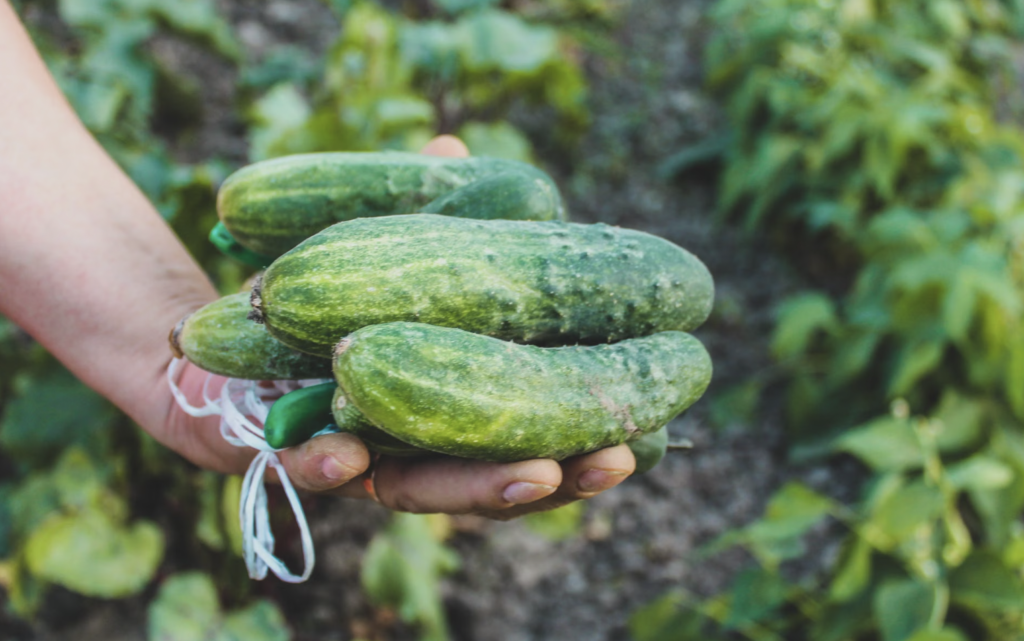
A close-up of hand holding freshly harvested cucumbers in a vibrant garden setting.
The Two Training Rules That Save Your Plants
Most vertical cucumber disasters come down to a single moment of impatience. Two rules matter more than everything else:
Never force a vine sideways. If a vine is heading the wrong way, coax it gradually over several days. Bending a rigid, established stem sharply cracks the vascular tissue inside and everything above that break dies. Gentle and gradual, always.
Never remove the tendrils. Those curly little grabbers are the plant’s entire anchor system. Cut them off and you’ll be manually tying every section forever, with a plant that loses its grip in wind. Let them do their job.
One myth worth busting: you don’t need slings, hammocks, or nets to hold up the fruit. Cucumber vines are perfectly strong enough to carry their own mature cucumbers, the fruit won’t tear itself off. Skip the fuss.
In our experience, the gardeners who struggle with vertical cucumbers are almost always the ones who try to install the vine rather than invite it. They’ll wrestle a stubborn three-foot vine across the bed in one go, snap something without realizing it, and watch the top half wilt a few days later. The ones who succeed do something much lazier: they wander past every few days, nudge whatever’s heading the wrong way an inch or two closer to the trellis, and let the plant’s own tendrils finish the job. Cucumbers are enthusiastic climbers, they just need a suggestion, not an argument.
Cucumber Care: Water, Feeding, Pruning
Watering (more than you think). Cucumbers are about 95% water, and here’s the counterintuitive part: vertical growing increases water demand, because elevated containers and raised beds drain faster than ground-level soil, and the open canopy loses moisture more freely. In peak summer, a single plant can want half a gallon to a gallon a day. Water deeply and consistently erratic moisture is the main cause of bitter cucumbers.
Critically,
water at the soil line, never over the foliage. Wet leaves are exactly what powdery and downy mildew need. Drip irrigation or a soaker hose along the trellis base is ideal, ideally on a timer running early morning and late afternoon. See our DIY drip irrigation guide. A layer of mulch at the base helps hold moisture steady.
Feeding. Cucumbers are heavy feeders. Mix compost or manure into the soil before planting, then side-dress with more compost, a slow-release fertilizer, or compost tea in early summer as the vines take off and again as fruiting hits its stride. Our NPK ratios guide and compost tea guide can help.
Pruning. Optional but useful for tidy, productive vines. Prune the secondary side vines, never the main leader, cutting close to the main stem with bypass pruners (anvil pruners crush the tissue). Many gardeners also remove the lowest fruit and shoots so the plant channels energy upward. Don’t overdo it; those leaves power the plant.
Growing Vertical Cucumbers in Containers
You don’t need a garden bed at all. A vining cucumber grows happily in a large pot, aim for at least 5 gallons, ideally bigger with a trellis or teepee set into the container itself, or a panel fixed to the wall behind it. It’s one of the most productive things you can grow on a balcony or patio.
Two container-specific tips matter. First, anchor the structure: a fully loaded vine is top-heavy, and one gusty afternoon can tip the whole pot over, so bracket the trellis to a wall or railing in windy spots. Second, water even more attentively pots dry out faster than beds, and a big cucumber vine in a container in July can be thirsty twice a day. Position the pot against a sunny wall if you can; the wall radiates stored heat in the evening and can extend your growing window by a week or two at each end of the season. Our container gardening guide for beginners covers pot sizing and drainage.
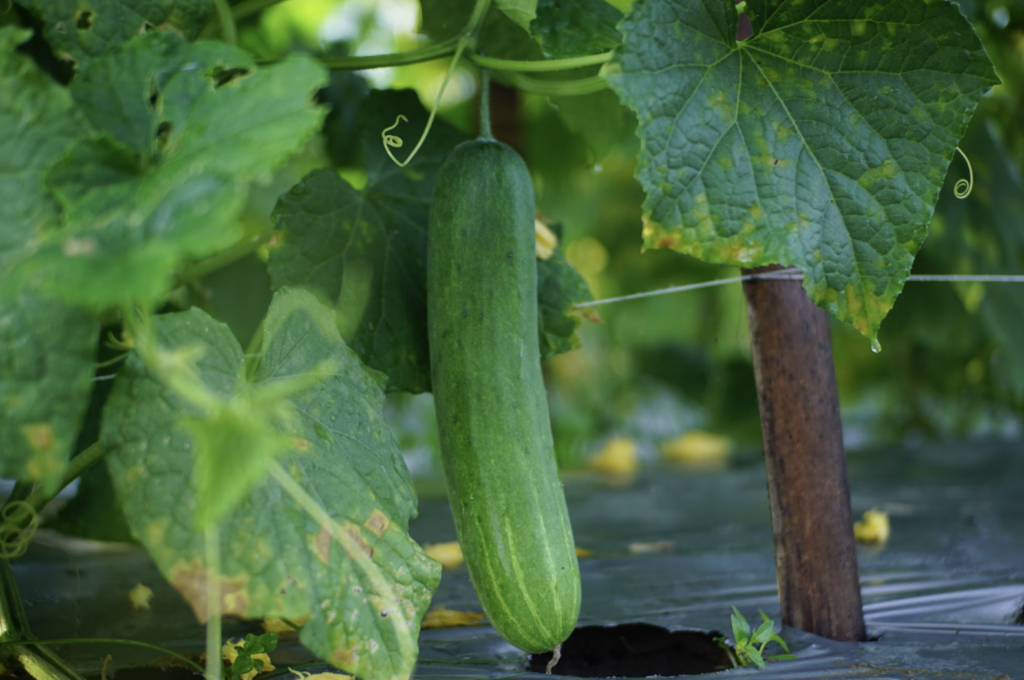
Close-up of a ripe cucumber hanging on the vine in a lush greenhouse setting
Harvesting Vertical Cucumbers
This is where vertical growing really pays off, every cucumber is visible at a comfortable height.
Pick at the right size. Roughly 6 to 9 inches for slicers, 4 to 6 inches for pickling types, or whatever your variety’s packet specifies. Don’t wait.
Harvest every 1 to 2 days during peak production. This is the productivity secret: leaving oversized fruit on the vine signals the plant to slow down or stop making new cucumbers. Constant picking keeps it going.
Cut, don’t pull. Snip the stem about half an inch above the fruit with pruners or a sharp knife. Yanking or twisting damages the vine and can tear off the tendril attachments holding your plant to the trellis, undoing weeks of climbing in one careless tug.
Expect a healthy vertical plant to give you roughly 7 to 11 pounds of fruit across a 6 to 8 week window. Store cucumbers in the fridge and use them within about a week or turn a glut into pickles, which is exactly what pickling varieties were bred for.
And a glut is likely, which is part of the fun. Beyond the obvious salads and sandwiches, homegrown cucumbers make wonderful quick refrigerator pickles (ready in a day, no canning required), cooling summer soups, infused water, and tzatziki. They’re low in calories and high in water, vitamin K, and antioxidants and because you’re picking them at their peak rather than after a week in transit, the crunch and flavor are in a different league from supermarket fruit. Don’t peel them unless you must: much of the nutrition sits in the skin, and trellised cucumbers stay clean enough that a quick rinse is all they need.
Common Problems and How to Fix Them
Problem
Likely Cause
The Fix
Vine won’t climb the trellis
Bush variety, or training started too late
Use a vining type; start guiding at 8–12 inches
Vine died above a bend
Stem forced sideways and cracked
Redirect vines gradually over days, never sharply
Section broke away under fruit
Supports spaced too far apart
Space horizontal supports 6–8 inches apart
White powdery leaves
Powdery/downy mildew from wet foliage
Water at the soil line only; keep the canopy open
Bitter cucumbers
Inconsistent watering or heat stress
Water deeply and consistently; mulch
Fruit stopped forming
Oversized cucumbers left on the vine
Harvest every 1–2 days
Trellis leaning or tipping
Underbuilt for a loaded vine
Drive posts 12+ inches deep; anchor to a wall or fence
Flowers but no fruit
Poor pollination
Invite bees with nearby flowers; hand-pollinate if needed
Nb: Cucumber beetles are the other pest to watch, since they can spread bacterial wilt. row covers early in the season help, but remove them at flowering so bees can reach the blossoms. Our companion planting guide suggests helpful neighbors, and beneficial insects do a lot of the pest work for you.
Is Growing Cucumbers Vertically Worth It?
Without question, it may be the single highest-return change you can make to how you grow them. You get straighter, cleaner, better-colored fruit; markedly less disease; a fraction of the footprint; and harvests you can actually see and reach. For small-space and urban gardeners it’s transformative, and even in a big garden it frees up room for everything else you want to grow.
Put up a trellis this spring, plant a vining variety at its feet, and give it a nudge in the right direction, then stand back and let the tendrils do the rest. It’s the rare gardening upgrade where the plant does most of the work and you get all the credit.
Frequently Asked Questions
Do cucumbers need a trellis? Not strictly, but vining types grow far better with one. Trellised cucumbers produce straighter, cleaner fruit with much less disease, take up a fraction of the space, and are far easier to harvest. Bush varieties don’t climb and don’t need support.
Which cucumber varieties climb? Vining (indeterminate) varieties climb using tendrils; bush types do not. Good climbers include ‘Marketmore 76’ (great for beginners and disease-resistant), ‘Suyo Long’ for hot climates, ‘Homemade Pickles’, ‘Sumter’, and ‘Mini Munch’ for small spaces.
How tall should a cucumber trellis be? About 5 to 6 feet is ideal, tall enough for vigorous vines but still within easy reach at harvest. Drive posts at least 12 inches into the ground, and space horizontal supports 6 to 8 inches apart so tendrils always have something to grab.
When should I start training cucumbers up a trellis? Start when vines are 8 to 12 inches long, before the stems become woody and brittle. Gently guide them to the support and let the tendrils grip; check every 3 to 4 days to redirect wandering vines.
How far apart should I plant trellised cucumbers? Closer than the packet suggests for ground growing, since vertical plants don’t compete for horizontal light. Space slicing cucumbers 12 to 24 inches apart and pickling types 12 to 18 inches along the trellis.
Do I need to support cucumber fruit on a trellis? No. Cucumber vines are strong enough to hold their own mature fruit without slings or nets. Just don’t cut the tendrils, they’re the plant’s anchor system and keep it attached to the trellis.
Why are my vertically grown cucumbers bitter? Bitterness comes from stress, usually inconsistent watering or heat. Vertical plants actually need more water than ground-grown ones because the soil drains and dries faster, so water deeply and consistently at the soil line, and mulch the base.