


As we navigate the ecological landscape of 2026, the Tasmanian devil (Sarcophilus harrisii) remains at a critical crossroads. Once the apex predator of the entire Australian mainland, this iconic marsupial is now restricted almost exclusively to the island state of Tasmania. The question of why the Tasmanian devil is endangered is not answered by a single factor, but rather a complex interplay of genetic isolation, anthropogenic pressure, and a biological anomaly that has baffled scientists for decades.
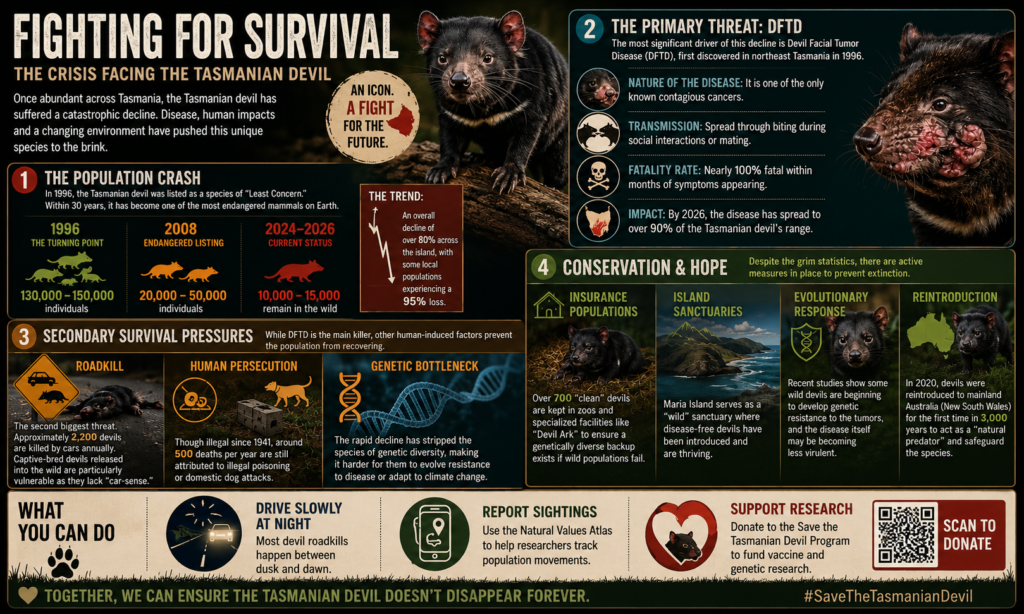
In 1996, the Tasmanian devil was listed as a species of “Least Concern.” Within 30 years, it has become one of the most endangered mammals on Earth.
-
1996 (The Turning Point): 130,000 – 150,000 individuals.
-
2008 (Endangered Listing): Population dropped to approx. 20,000–50,000.
-
2024–2026 (Current Status): Estimates suggest as few as 10,000–15,000 remain in the wild.
-
The Trend: An overall decline of over 80% across the island, with some local populations experiencing a 95% loss.
Some Major Threats to the Tasmanian Devils
The Tasmanian Devil is endangered primarily due to Devil Facial Tumour Disease (DFTD), a rare, contagious cancer that spread through biting. Since its discovery in 1996, DFTD has reduced wild populations by over 80%. Some Other contributing factors include habitat loss, road accidents, and competition with invasive species like feral cats and foxes.
-
Devil Facial Tumour Disease
The cancer cells themselves are the infectious agent. Because Tasmanian devils have remarkably low genetic diversity, their immune systems fail to recognize the foreign cancer cells from another devil as “non-self.” This allows the tumors to grow unchecked, typically appearing around the mouth and neck, eventually leading to organ failure or starvation within six months of clinical onset.
-
Nature of the Disease: It is one of the only known contagious cancers.
-
Transmission: Spread through biting during social interactions or mating.
-
Fatality Rate: Nearly 100% fatal within months of symptoms appearing.
-
Secondary Survival Pressures
While DFTD is the main killer, other human-induced factors prevent the population from recovering:
-
Roadkill: The second biggest threat. Approximately 2,200 devils are killed by cars annually. Captive-bred devils released into the wild are particularly vulnerable as they lack “car-sense.”
-
Human Persecution: Though illegal since 1941, around 500 deaths per year are still attributed to illegal poisoning or domestic dog attacks.
-
Genetic Bottleneck: The rapid decline has stripped the species of genetic diversity, making it harder for them to evolve resistance to disease or adapt to climate change.
-
Climate Change: Increasing aridity reduces prey availability, further stressing small, isolated populations.
“DFTD has wiped out over 90% of the population in some high-density areas. The
emergence of a second strain, DFT2, in 2014 has further complicated recovery efforts,
requiring a multi-faceted immunological response from researchers.”
Where Do Tasmanian Devils Live? Habitat Mapping & Range
For decades, the mention of a “Tasmanian devil” brought to mind a singular, rugged island at the edge of the world. However, as of 2026, the geography of this iconic marsupial is shifting. From the dense rainforests of the Tarkine to experimental safe havens on the Australian mainland, understanding where these creatures live is key to ensuring they don’t follow the Thylacine into the history books.
In Tasmania, their range is surprisingly broad. You won’t find them in the highest alpine peaks or heavily urbanized centers like Hobart’s CBD, but they occupy almost every other niche:
-
Coastal Heath & Rangelands: These are “high-density” zones. Devils love the mix of open grazing land and scrub, which provides ample carrion (dead animals) and easy travel paths.
-
Dry Sclerophyll Forests: The classic Australian “bush” is their preferred neighborhood. The open understory allows them to use their keen sense of smell to track food over long distances.
-
Rainforest Borders: While they venture into the fringes of Tasmania’s wet forests, they generally avoid the deep, lightless interior where hunting is more difficult.
The New Frontiers: Beyond the Island
As of 2026, the map of “Devil Territory” includes crucial new dots:
-
Mainland Australia: Thanks to the pioneering work of projects like Aussie Ark, small populations of devils now live in large, fenced sanctuaries in New South Wales (Barrington Tops). These “rewilding” sites act as an insurance policy against total extinction.
-
Maria Island: This offshore “fortress” remains a disease-free sanctuary where a healthy population thrives in the wild, separated from the DFTD-stricken mainland of Tasmania.
- The Far Northwest: Home to some of the most genetically diverse and DFTD-resistant
populations.
The Ecological Ripple Effect: Why Their Survival Matters to You
When we think of the Tasmanian devil, we often focus on its fierce reputation or its struggle against disease. But the survival of this apex predator isn’t just about saving a unique species; it is about protecting the stability of the entire Australian ecosystem. Because devils are a “keystone species,” their presence—or absence—creates a ripple effect that touches everything from the health of our forests to the safety of our suburbs.
Controlling Pests and Preventing “Carrion Overload”
The Tasmanian devil is nature’s ultimate cleanup crew. As the world’s largest carnivorous marsupial, their diet consists primarily of carrion (dead animals). While this might sound gruesome, it is an essential public health service. By consuming carcasses quickly, devils prevent the buildup of rotting organic matter that would otherwise become a breeding ground for blowflies and bacterial pathogens. Without them, we face a “carrion overload” that can lead to disease outbreaks in both livestock and wild animal populations.
Beyond cleaning, devils act as a vital check on invasive species. On the Australian mainland, the absence of devils has allowed feral cats and European red foxes to hunt native wildlife into near-extinction. In Tasmania, however, the devil’s presence creates a “landscape of fear” that limits the activity of these invasive predators. By protecting the devil, we are indirectly protecting dozens of smaller, vulnerable species like the Eastern barred bandicoot and various ground-nesting birds.
Conservation Success Stories: Hope on the Horizon
While the narrative surrounding the devil has been grim for years, 2026 marks a period of genuine optimism. Intensive intervention is finally yielding results that suggest the species can win its fight for survival.
The Mainland Reintroduction Project
In 2020, devils were released into a sanctuary in New South Wales, the first time they have been on the Australian mainland in 3,000 years. One of the most ambitious conservation projects in history reached a milestone this year. The reintroduction of Tasmanian devils to the Australian mainland specifically within the fenced wild sanctuaries of New South Wales has proven that these animals can adapt and thrive in their ancestral territory. These “mainland devils” serve as a crucial genetic insurance policy. If the wild Tasmanian population were to collapse, these healthy, disease-free individuals ensure the species survives and can eventually be used to repopulate the island.
Is Immunity Evolving?
Perhaps the most incredible news comes from the wild populations themselves. For years, Devil Facial Tumor Disease (DFTD) was a 100% fatal death sentence. However, recent genetic monitoring has shown that some wild devils are fighting back. Researchers have identified “evolution in real-time,” where certain individuals are developing a natural immune response to the tumors. We are seeing a shift where the disease is becoming more like a chronic condition rather than a rapid killer, giving the species the window it needs to coexist with the virus.
Insurance Populations:
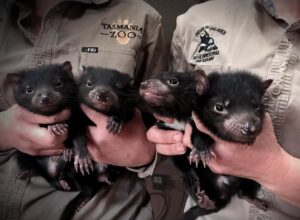
Over 700 healthy devils are housed in bio-secure mainland facilities to ensure the species survives if wild populations collapse. Trowunna Wildlife Sanctuary has been successfully breeding Tasmanian Devils every year since 1983 – helping protect this iconic and endangered species.
How to Support Tasmanian Devil Conservation: Top 5 Charities
For thoseready to take action, supporting established organizations is the most effective way to help. These groups fund vaccine research, manage insurance populations, and build “devil-proof” fencing.
1. Save the Tasmanian Devil Appeal
The official fundraising entity for the state government’s response. They focus heavily on DFTD vaccine research and wild population monitoring.
2. Aussie Ark
A leader in mainland rewilding. Aussie Ark manages a “Devil Ark” sanctuary in NSW, maintaining a genetically diverse population away from the disease-ravaged island.
3. Wildcare Tasmania
A grassroots organization that supports volunteer efforts to rehabilitate injured devils and maintain habitat integrity.
Some FAQ about Tasmanian Devils
1. Why are they called “Devils” if they aren’t actually dangerous?
Early European settlers in Tasmania were terrified by the unearthly, rasping screams and growls coming from the bush at night. When they saw a black animal with red ears and powerful jaws scavenging in the shadows, they dubbed it a “Devil.” Despite the name and the noise, they are shy, solitary creatures that prefer to avoid human contact.
2. Are Tasmanian devils dangerous to humans or pets?
Generally, no. Tasmanian devils are not aggressive toward humans and will typically flee if encountered. While they have one of the most powerful bites in the animal kingdom, they only use it for scavenging or defending themselves when cornered. As discussed in our safety guide, the contagious cancer (DFTD) affecting them cannot be transmitted to humans or domestic pets.
3. How did the Devil Facial Tumour Disease (DFTD) actually start?
Scientific research suggests the disease originated from a single devil’s nerve cells (Schwann cells) in the late 1990s. Because Tasmanian devils have very low genetic diversity, their immune systems don’t recognize these “foreign” cancer cells as a threat when they are bitten by an infected individual, allowing the cancer to grow and spread like a virus.
4. Is there a “cure” for the facial tumor disease?
There is no “cure” in the traditional sense, but there is immense hope. Scientists have developed an experimental vaccine, and more importantly, researchers have observed “rapid evolution” in wild populations. Some devils are developing a natural immune response to the tumours, suggesting the species is fighting back on a genomic level.
5. Why do Tasmanian devils scream so loudly?
The “screaming” is actually a complex system of communication used during communal feedings. Since devils are scavengers, they often gather around the same carcass. The vocalizations are a way of establishing a “pecking order” to reduce actual physical fighting, which helps minimize the risk of spreading DFTD through biting.
6. Is it true that Tasmanian devils can eat bone?
Yes. They are one of the few scavengers capable of consuming an entire carcass, including bones, fur, and gristle. Their jaws are designed for crushing, allowing them to act as “nature’s vacuum cleaners.” By eating every part of a dead animal, they prevent the spread of maggots and diseases like blowfly strike, which is a major benefit to local ecosystems and farmers.
7. How small are Tasmanian devils when they are born?
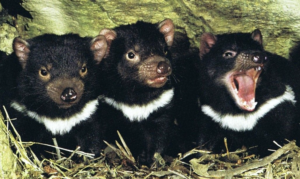
They are incredibly tiny. A mother can give birth to up to 50 “joeys,” each about the size of a grain of rice. However, since the mother only has four teats in her pouch, only the first four to arrive survive. They remain in the pouch for about four months before emerging.
8. Are they actually being reintroduced to mainland Australia?
Yes! In a historic conservation move, Tasmanian devils were reintroduced to a protected sanctuary in New South Wales in 2020. This “Aussie Ark” project aims to create an insurance population and restore the ecological balance on the mainland, where devils haven’t lived in the wild for over 3,000 years.
9. Do Tasmanian devils hunt in packs like wolves?
No. They are primarily solitary animals. While you may see a group of them together at a large carcass, they do not hunt cooperatively. They are “solitary but social,” meaning they have a well-defined social structure and home ranges that overlap, but they prefer to travel and hunt alone.
10. What happens to the environment if the Tasmanian devil goes extinct?
The ecological ripple effect (trophic cascade) would be devastating. Without devils to control feral cat and fox populations, small native mammals and ground-nesting birds would likely face extinction. Additionally, the buildup of unconsumed carrion would lead to an increase in pest insects and bacteria in the soil.
11. How long do Tasmanian devils live?
In the wild, a healthy Tasmanian devil typically lives for 5 to 6 years. In captivity, where they are protected from disease and road hazards, they can live up to 8 years. Their short lifespan is one reason why the rapid spread of DFTD is so threatening to their long-term survival.
12. Where is the best place to see Tasmanian devils responsibly?
While they are endemic to the island of Tasmania, seeing them in the wild is difficult due to their nocturnal nature. The most responsible way to see them is through “unzoo” environments or sanctuaries like Bonorong Wildlife Sanctuary or Devils@Cradle, where entrance fees directly fund DFTD research and conservation efforts.