


Most gardeners get about two months of coneflowers. They plant one variety, let it bloom, admire it in July, and by mid-August they’re looking at a bed of brown cones and wondering where summer went.
But coneflowers are capable of far more than that. With three deliberate techniques; staggering your varieties, chopping half your stems in spring, and deadheading with intent, the same plants can carry color from late spring clear through to frost. Some gardeners stretch it to five months. Learning how to grow coneflowers isn’t difficult; this native prairie wildflower practically raises itself. Learning to grow them for season-long color is a different skill, and it’s the one this guide is about.
(New to echinacea entirely? Our companion guide on growing echinacea covers seed starting, germination, and its medicinal uses. This one is about squeezing every last week of color out of the plants once you have them.)
How Do You Get Coneflowers to Bloom All Season?
Plant several varieties with staggered bloom times, give them 6 to 8 hours of sun and well-drained soil, and deadhead spent flowers back to a leaf node to redirect energy into new buds. In late spring, apply the Chelsea chop, cut half your stems back by a third, to delay part of the display and extend it by weeks. Then stop deadheading in late summer and leave the final flush standing for birds.
The key insight: each coneflower stem has one terminal bud that blooms for a few weeks. Cut it before it sets seed and the plant produces lateral growth and more buds. That’s the whole mechanism.
First, the Mechanism (Why Deadheading Works)
Understanding this makes every technique below make sense.
A coneflower grows as a basal mound of foliage from which upright stems rise. Each stem carries a terminal bud that opens and blooms for a few weeks. Left alone, that flower fades, sets seed, and the stem’s job is done, the plant redirects everything into reproduction.
Cut that spent flower off before it seeds, and the calculation changes. Energy shifts from reproductive to vegetative growth, the stem pushes out lateral growth, and lateral growth means more buds and more blossoms. You haven’t taken anything from the plant; you’ve told it that its work isn’t finished.
That single principle: interrupt seed-set, get more flowers “is the engine behind season-long coneflowers”.
Technique 1: Stagger Your Varieties
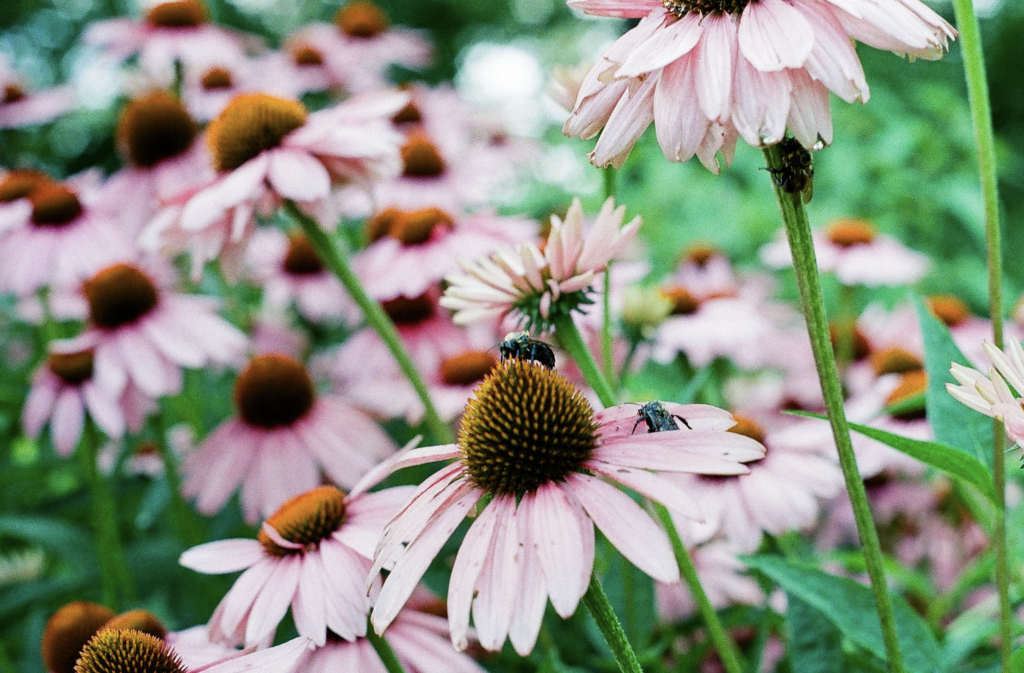
The easiest win, and the one most gardeners skip entirely: different coneflower varieties bloom at different times. Plant one cultivar and you get that cultivar’s window. Plant strategically across early, mid, and late bloomers and you can have coneflowers from roughly May into September, up to five months.
A few things worth knowing when choosing:
- E. purpurea (purple) and E. paradoxa (yellow) are often described as continuous bloomers, though both tend to be most vigorous early, before summer heat sets in.
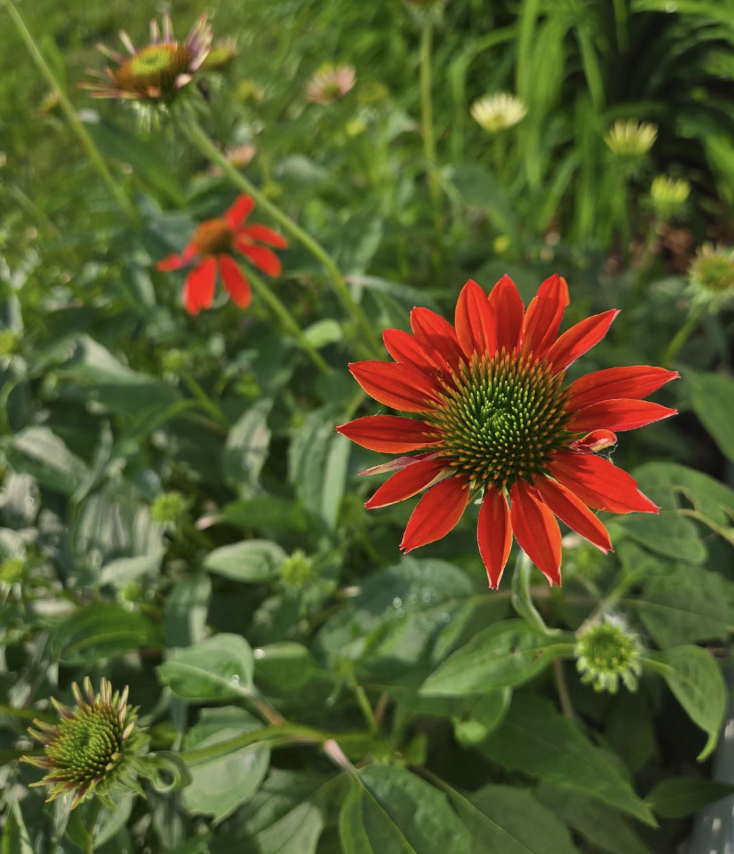
- Compact red and orange cultivars frequently run later than tall purples, useful for the back end of the season.
- Performance varies enormously by exposure, moisture, and soil. A neighbor’s tall purple echinacea in partial shade may be in full glory while your compact reds in full sun are still in bud. Don’t over-plan; plant a range and observe.
| Type | Rough timing | Notes |
|---|---|---|
| E. purpurea (‘Magnus’, ‘Ruby Star’) | Early–mid | The workhorse; vigorous early, reliable |
| E. paradoxa (yellow) | Early–mid | Drought-tough; unusual yellow cone |
| ‘White Swan’ | Mid | Superb cut flower; cools a hot palette |
| Compact reds/oranges | Mid–late | Often later than the purples |
| ‘Kim’s Knee High’ (12–18 in) | Mid | Front-of-border and container work |
The practical advice: buy three or four different cultivars rather than a dozen of one. You’ll lose nothing in impact, coneflowers read beautifully in mixed drifts and you’ll gain weeks of color for exactly the same money.
Technique 2: The Chelsea Chop (The Real Secret)
This is the technique that separates gardeners who get two months of color from those who get four, and it’s genuinely underused.
What it is: in late spring, cut each stem back by one-third to one-half its height, making the cut on the diagonal, just above a leaf node. (The name comes from its timing around the Chelsea Flower Show in late May.)
What it does, two things at once:
- It forces bushier growth. The plant responds with sturdier, tighter, fuller stems that are far less likely to grow leggy or flop by season’s end. No staking required.
- It delays blooming. Chopped stems flower later than unchopped ones, which is exactly what you want for the late-summer garden.
And here’s the clever part. You don’t have to chop everything. Two variations turn a pruning technique into a bloom-extension strategy:
- Chop alternate stems on the same plant, some bloom on schedule, others weeks later.
- Chop only half your plants: the unchopped drift blooms early, the chopped drift picks up as the first fades.
Either way, you’ve split one bloom window into two overlapping ones. It costs you ten minutes in May.
Important limits: the Chelsea chop only works on clumping, multi-stemmed perennials. Coneflower, black-eyed Susan, goldenrod, sneezeweed, salvia, and yarrow are all good candidates. Never try it on one-time bloomers, single-stemmed plants, or woody-stemmed plants as one writer memorably put it, the amputations would be homicidal to this season’s flowers.
In our experience, the barrier to the Chelsea chop isn’t knowledge it’s nerve. Standing over a healthy, vigorous plant in May with a pair of shears, about to cut a third of it away for no visible reason, feels like vandalism. Everything in you says leave it alone, it’s doing fine. The gardeners who do it anyway are the ones with waist-high, self-supporting drifts still throwing flowers in September, while the cautious ones are out buying stakes in August to prop up leggy plants that finished blooming weeks ago. If it helps, start by chopping just one plant this year and leaving its neighbor untouched. By September the comparison will have made the argument for you far better than we can.
Technique 3: Deadhead With Intent
Coneflower stems are thick and coarse, too tough to pinch off with your fingers like a petunia. Use sharp bypass pruners or garden snips, wiped down with rubbing alcohol or diluted bleach beforehand.
Where to cut: not just the flower head. Cut the stem just above a leaf node, or right down at the base where it originates. That’s what triggers the lateral growth. Snipping off only the cone leaves you a bare stick and achieves far less.
When to cut: here’s a genuine judgment call. Cut as soon as the petals fade for the fastest rebound and maximum new buds. Or wait until the petals have fully browned if you’re in no rush, plenty of experienced gardeners do exactly this, because with a big drift there’s simply no need to hurry the replacements along.
After deadheading, give the plant a good watering to help it recover from the stress. Skip the fertilizer, though, coneflowers bloom better lean, and feeding produces floppy growth.
A bonus that costs nothing: cutting coneflowers for the vase is deadheading. They’re long-lasting, architectural cut flowers, so every bouquet you bring inside is also a bloom-extension technique. Cut at their peak and the plant responds exactly as it would to deadheading.
The Deadheading Endgame: Know When to Stop
Here’s where season-long color and wildlife have to negotiate and there’s a genuinely elegant answer.
Deadhead through the blooming period to keep color coming and the planting looking sharp. Then, in late summer, stop. Leave the final flush of flowers standing.
Why:
- Goldfinches. They’ll work coneflower seed heads for a very long time through fall and winter, it’s one of the great pleasures of a prairie-style border.
- Winter interest. Those blackened cones on stiff stems look wonderful in frost and snow.
- Free plants. Older varieties self-sow, giving you drifts for nothing.
- Native bees overwinter inside the hollow stems, so cut back in late winter, not fall, and leave 12–24 inches standing.
You get months of tidy color and a garden full of birds. There’s no real trade-off if you simply change your behavior in August.
The Hybrid Trap (An Honest Warning)
This is the nuance almost nobody flags, and it matters if you’re buying plants for a wildlife garden.
Newer coneflower hybrids often produce no viable seed and will not self-sow. That sounds like a feature, no unwanted seedlings! But it has a consequence: those hybrids are also of little interest to birds. No viable seed means no goldfinch food. You can leave the seed heads standing all winter and nothing will come.
So decide what you want:
- Want goldfinches, self-sowing, and free plants? Grow species types and older varieties — E. purpurea, ‘Magnus’, ‘White Swan’, ‘Ruby Star’.
- Want controlled, tidy, no-volunteers color in exotic shades? Modern hybrids are excellent — just don’t expect them to feed birds.
This pairs with the other rule worth repeating: skip double-petaled cultivars if you care about pollinators, since all those extra petals block bees from reaching the nectar in the open cone. Between the doubles and the sterile hybrids, it’s entirely possible to plant a bed of gorgeous coneflowers that does nothing whatsoever for wildlife. Choose knowingly.
The Growing Conditions That Underpin It All
None of the above works on an unhappy plant. The good news is that coneflowers ask for very little:
Sun. 6 to 8 hours daily. One exception worth knowing: in zone 8 and warmer, a little partial shade actually helps, it keeps the flower colors from fading in brutal sun.
Soil. Well-drained above all. Coneflowers tolerate a wide range of soils and prefer some organic matter, but don’t over-feed, rich conditions cause weak, floppy growth and fewer flowers.
Water. Regular water through the first year to establish. After that they’re strongly drought tolerant thanks to deep roots, a light yearly top-dressing of compost is all the input they’ll ever need.
Spacing. They have strong, deep roots that let them perform well even when layered tightly beside other plants — which is why they work so well in dense, modern meadow-style planting.
Zones 3–9, blooming midsummer and continuing sporadically until frost.
For the full establishment picture, seed stratification, the no-flowers-in-year-one truth, and dividing. see our echinacea growing guide.
A Realistic Expectation
One honest note before you plan a five-month display on paper: coneflower performance varies enormously, and not in ways you can fully control.
Exposure, moisture, nutrients, and soil quality all shift the timing, sometimes dramatically. In the same neighborhood, in the same week, one gardener’s tall purple echinacea in partial shade can be in full glorious bloom while another’s compact reds in full sun are still sitting in bud. Neither gardener did anything wrong. A cool, wet spring interrupted by hot dry spells will scramble the schedule again.
So treat the techniques here as stacking the odds, not setting a timetable. Plant a range of varieties, chop half of them, deadhead as you go, and you will reliably get substantially more color than you would have. Whether that lands at three months or five depends on your season. Gardening rewards the gardener who plants for probability rather than precision.
Designing With Coneflowers
Coneflowers are versatile enough for almost any style, modern meadows, low-maintenance borders, drought-tolerant landscapes, and even mixed containers.
- Mass them. Coneflowers are robust bloomers that look best in large swaths, not singles. Three or five minimum.
- Dot them through existing beds with grasses and other perennials for a prairie effect.
- Contrast the forms. Coneflower’s daisy shape sings against spiky salvia or liatris and airy ornamental grasses. See best low-maintenance perennials for full sun for a full palette.
- Play the palette. They come in nearly every shade now, white cools a hot scheme, orange and red heat one up.
- Use them in containers. Compact cultivars work well in pots (see container gardening for beginners).
- Layer for succession. Pair with black-eyed Susans and daylilies so something is always peaking.
As a native, echinacea also belongs in native plant landscaping, a pollinator garden, or a border of native perennials.
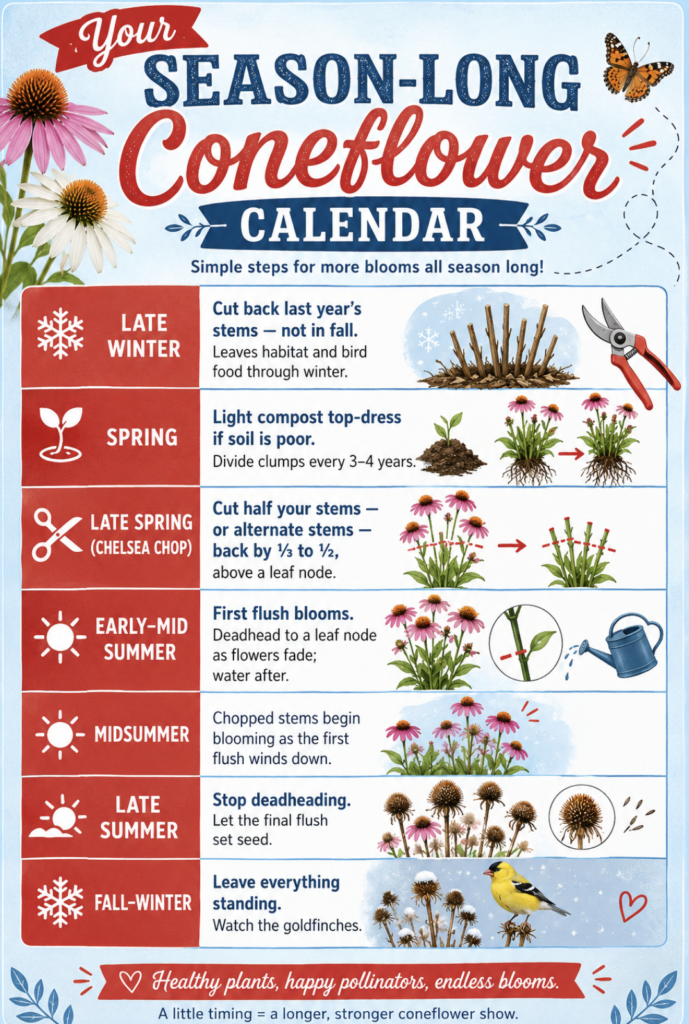
Your Season-Long Coneflower Calendar
Common Problems and How to Fix Them
| Problem | Likely Cause | The Fix |
|---|---|---|
| Bloom finished by mid-August | One variety, no chop, no deadheading | Stagger varieties; Chelsea chop half your stems; deadhead to a leaf node |
| Deadheading isn’t producing new buds | Cutting only the cone, not back to a node | Cut just above a leaf node or at the stem base |
| Tall plants flopping by late summer | Rich soil, shade, or no Chelsea chop | Chop in late spring; stop feeding; ensure full sun |
| Flower colors look washed out | Intense sun in a hot climate (zone 8+) | Give a little afternoon shade |
| Seed heads left up, but no birds came | Modern hybrid with no viable seed | Grow species types or older varieties for goldfinches |
| Bees ignoring the flowers | Double-petaled cultivar | Choose single-flowered types with an open cone |
| Coneflowers everywhere | Older varieties self-sow freely | Deadhead through the season; that’s the trade-off |
| Center of clump dying out | Overdue for division | Divide every 3–4 years in spring or early fall |
Is It Worth the Effort?
Very much so, and “effort” is generous. Ten minutes with pruners in late May and a periodic snip through July is the entire investment. In return, a plant that would have given you two decent months instead carries the border from late spring to frost, then hands the garden over to the goldfinches for winter.
That’s the real appeal of coneflowers. They’re tough enough to thrive on neglect, but they’re also responsive, they reward a gardener who understands what they’re doing. Cut a stem at the right moment and the plant answers with more flowers. There aren’t many places in gardening where the cause and effect are that direct, or that satisfying.
Ready to build the border? Pair coneflowers with black-eyed Susans, the classic combination and another Chelsea chop candidate, plus daylilies and other low-maintenance perennials for full sun. For the shady half of your garden, see growing hostas, and for a fully native scheme, best native perennials for US gardens. Explore the full Ornamental Perennials collection, part of the broader EcoGardenHub Plant Library.
Chop half your stems this May, snip the spent flowers as they fade, then put the pruners down in August and let the goldfinches have the rest.
Frequently Asked Questions
- How do I make my coneflowers bloom longer? Three techniques stack: plant several varieties with staggered bloom times, apply the Chelsea chop to half your stems in late spring to delay part of the display, and deadhead spent flowers back to a leaf node to trigger new buds. Together they can extend bloom from about two months to four or five.
- What is the Chelsea chop for coneflowers? Cutting each stem back by one-third to one-half in late spring, on the diagonal just above a leaf node. It produces bushier, sturdier plants that won’t flop, and delays blooming. Chop only alternate stems or only half your plants to stagger the display and extend the season.
- Where do you cut when deadheading coneflowers? Cut the stem just above a leaf node, or at the base where it originates, not just the cone. That redirects energy from seed production into lateral growth, which is what produces more buds. Use sharp pruners; the stems are too thick to pinch.
- Should I deadhead coneflowers or leave the seed heads? Do both. Deadhead through the blooming period for continuous color, then stop in late summer and leave the final flush standing. Goldfinches feed on the seed heads all winter, the cones add winter structure, and native bees overwinter in the hollow stems.
- Why aren’t birds eating my coneflower seed heads? Many newer hybrids produce no viable seed and won’t self-sow, which also means they offer nothing to birds. If you want goldfinches, grow species types or older varieties like E. purpurea, ‘Magnus’, or ‘White Swan’.
- Do coneflowers need fertilizer to bloom more? No, the opposite. Over-feeding causes weak, floppy growth and fewer flowers. A light annual top-dressing of compost is plenty in average soil. Sun and correct pruning drive blooming far more than nutrition does.
- Why are my coneflower colors fading? Intense sun in hot climates can wash out the flower color. In zone 8 and warmer, a little partial shade keeps the tones richer while still giving enough light for strong blooming.